We are constantly looking for material to use and, when found, I always make a copy and place it in the "Gee Whiz" box for future reference. After a while the pages pile up but today I decided to go through them and re-discovered all sorts of treasures. Today's search was especially fine as the announcement of a grand opening was made 79 years ago today on June 7, 1934!
What was it?
Chilliwack's new athletic park and grounds on Young Road, a place for all to gather and spend a fine evening watching and cheering and chatting with others! Chilliwack's big day "June 13, 1934".
Chilliwack Progress, June 7, 1934, page 4
As someone who enjoys puttering about on research projects at home (with the baseball game on) I thought this announcement would be a good one to share. Love the graphics! Check out our Chilliwack baseball video and for added fun the classic baseball comedy from Abbott and Costello!
Souvenir China from the Green Heart of British Columbia
With some changes to our display building it was good to have some of our commemorative china return to the curatorial department for care and attention. As I worked through the several examples in the museum's collection I was reminded of an earlier Museum and Archives exhibit that focused upon the promotion of Chilliwack and district to locals and visitors.
Souvenir china was, at one time, extremely popular and over the years I have seen examples from across British Columbia, Canada and elsewhere.
Mt Cheam Souvenir China Set, comprising plate, creamer and sugar. Royal Winton, Grimwades, England. 2000.010.001.1-3
Honey Extractor used by "Honey" Johnson in the early Chilliwack Bee Keeping Industry.
Day of the Honey Bee: May 29, 2012
They buzz
about our gardens and fields, working their business, passing from one set of
coloured petals to another. Steadily gathering, they harvest the goodness that
becomes honey. I like watching them and enjoy their steady drone and attentive
focus. They do a grand job and I am grateful to them for their initiative and
company. We need
those comb creators for pollination and with the recent threats to them I thought
I would bring a bit of their local history to your attention.
It was
interesting that, while digging about on the Chilliwack Fruit Industry, I learned that at the same time there was a thriving local bee keeping industry. So far we have complied a list of early bee keepers working specifically in the Sardis area and have become aware that the bee keeping industry is not well represented in our object or archival collections.
For instance, although the Chilliwack
Museum is fortunate to have a few pieces of bee related equipment we do not have any early examples of local honey tins. These
cans could include custom made tins featuring graphics produced specifically for the firm
or a standardized pattern with space for a local name stamp to be applied. We would be most grateful to learn about any Chilliwack honey tins that have survived and we thank you for any help you might be able to provide. As always it does not have to be really old to be of historic interest to us. (I would also mention, at the same time, we only have one early
fruit manufacturer’s label from Storey Fruit Farms, Sardis, B.C.)
Turning to today, we have also learned that farmers lease bees from hive operators to ensure the pollination of their
crops; cranberries are one example where bees perform their duties with determination.
Apart from the production of honey, either creamed or liquid, the wax is also
an important commercial part of the industry. In a recent conversation with a commercial bee keeper I believe he told me that the wax is
used by the aviation industry. Eager to learn more I would enjoy hearing about other uses for bee related products or about local bee keeping history.
Please let us know what you
might have lurking around representative of bees, their keepers and their work and remember that the Day of the Honey Bee is just around the corner.
The Day
of the Honey Bee
Proclamation
Name of Day:
Day of the Honey Bee
Tuesday, May 29, 2012
WHEREAS the honey bee has, through its role as a pollinator, been
an important part of our agricultural heritage since ancient times and
WHEREAS the honey bee plays an essential role in the success of
agricultural enterprise in British Columbia and
WHEREAS the honey bee has been under serious threat due to disease
and environmental conditions that ultimately threaten the future of agriculture
in our province and
WHEREAS
it is in the interest of furthering the goal of improved agricultural
production to raise the awareness of the role of the honey bee and the plight
it faces NOW KNOW YE THAT We do proclaim and declare May 29, 2012 as “The Day of the Honey Bee”.
Chilliwack's Strand Theatre with Ben-Hur film posters!
Circa 1928. Image P3186
I always enjoy looking through our collections and discovering something new! Anytime there is an opportunity to browse through the pages of the Chilliwack Progress newspaper, which we have dating back to its origins in 1891, is always a bonus. One discovery leads to another and so it goes.
Recently we have been building up our knowledge of the fruit farming industry in Chilliwack and were delighted to find so much new information. Then searching through the online directories, courtesy of the Vancouver Public Library, we added to our findings. The scope of the fruit farming industry in Chilliwack is marvelous and has much potential for further study. I see a future exhibit in this!
Nevertheless while we look for one thing...we always find other interests.
It seems that Chilliwack was once, along with the fruit industry, a thriving bee-keeping community. As I scroll down the names of residents in Chilliwack, Sardis and Rosedale, in search of fruit related industry, I find other curiosities such as in the 1925 Wrigley's Directory the Palace of Sweets operated by J. Valalas, or C.J. Whittaker & Co. that sold farm implements locally. Still my favorite for the day, Mrs. K. Gregory pianist for the Strand Theatre! I can see her adding the soundtrack to the old silent films of the day! A little known and obscure fact that adds so much, I feel, to our knowledge of the Strand Theatre. From fruit to bees to the Strand and Ben-Hur! Who knew?
We may not know too much about these individuals yet, but they are there locked into our memory now, waiting for further discoveries that will add even more colour to this community's history. I wonder what this afternoon's discoveries will bring?
Incidentally the film Ben-Hur was produced in 1925!
Tomorrow individuals from around Chilliwack and District will gather at this community's war memorials. Behind the Chilliwack Museum is the community's cenotaph unveiled in 1923 with the leaded names of 99 service personnel from the First World War and 85 from the Second World War. We will remember them.
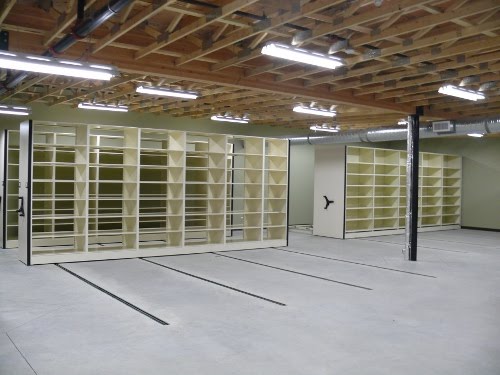
Now We Just Have to Move Everything Some remarkable changes have been made to the Chilliwack Museum and Archives and phase one of our new shelving has been completed. As the old Archives storage area will soon be the new research room, some of the Archival collection has already been transferred. Today also marks the first move of the object collection which numbers some 8000+ artifacts. The project will take some time to work through as storage locations are confirmed against the database. Phase 2 of the shelving project starts shortly and when completed, possibly by the end of July, we will really see some major changes in the look and feel of our renovated and new quarters.
It’s all too exciting! Since the shovels hit the ground on January 3, 2011 we have watched as our new addition has been set upon the landscape. Its been great to watch as the contractors set about their objectives with us on the sidelines, cheering amongst ourselves, as we saw each step completed. Today the painters have arrived and the rollers are rolling as the splash of colour brings a sense of completion to the interior walls. We are close to having our new addition and in just a few short weeks our new space will be ready for the next step.
That next round of excitement begins with the arrival and installation of state of the art rolling shelving. It will be magnificent once the installers have completed the shelving and the real fun begins. That is when the collections can return probably starting at the end of May or early June. Then it’s sorting out the collection locations on the database, which will take a bit of time, as we check and re-check ensuring that these items can be readily accessed.
The summer will be a busy time and the above only reflects the completion of the storage area. We still have a new research room to complete and we are actively engaged in raising funds to ensure that the new visitor’s area will be a warm and welcoming environment. After all, when you travel a long way to find your roots the memory of that discovery is all the more precious when found in a place we can all be proud of.
Our new addition is really coming along and each day we get a little bit closer to having more space for Chilliwack’s important collections. It is times, like these, that I think upon the staggering amount of packing and squirreling away of the collection while we wait in anticipation. The bubble wrap, tissue paper, storage boxes, places to put it all, etc.
Somehow it also reminds me of another time when in 2000 the British Columbia Museum’s Association co-hosted a conference with the Western Museum’s Association. Held at the Victoria Conference Centre one discussion stands out in particular, the amazing presentation made by Fred Wilson a conceptual artist whose discussion spoke of his work in partnership with museums. In a nutshell, Mr. Wilson challenges museums and their staff in their methods of interpretation and presentation. What are we really saying when we choose to bring together these ideas for public consumption?
However, returning to our current boxes and storage issues, and understanding that I love to segue, how does Mr. Wilson’s work relate to our current project? One example that Fred Wilson chose to highlight in his presentation was from a re-interpretation of exhibits at the highly acclaimed British Museum in London, England. In this fine setting Mr. Wilson discovered the original box used to transport the Rosetta Stone from Egypt to England thereby provoking a discussion of the removal of this type of object from its country of origin.
The Rosetta Stone, which is apparently the most visited object at the British Museum, has been on display since 1802 and in July 2003, on the 250th anniversary of the British Museum, Egypt first requested its repatriation. OK enough discussion, let’s add some personal thoughts and segues! Three things come to mind, apart from a discussion of the Rosetta Stone's repatriation.
Firstly that Mr. Wilson, in seeking powerful examples for his project, found this circa 1801 original storage box stored inside the British Museum. Amazing! Secondly, it reminds me of all those precious collections that come into the Museum and Archives in all styles of boxes and containers. We always check these thoroughly as at times these can be just as significant as the contents. Finally - that the British Museum is over 250 years old. Imagine! It reminds us that we, as museums and archives, collect all of these items not just for the present but for future generations. Maybe we do have a lot of material in storage, and perhaps it has not always been exhibited, but in the future, and specifically in 2207 the Chilliwack Museum and Historical Society will be 250 years old! Amazing – Imagine!
"This is so much more than a box!"
The new addition to the Chilliwack Museum and Archives will house collections relating to 10,000 years of human history in this area. It will be ready in the "flashiest of flashes!"
So - some time has gone by since the last blog but, like drones in a beehive, we have been extremely busy with our new addition. Construction started on January 3rd, 2011 and prior to that time we spent many days and hours creating a new storage plan blueprint and developing a fundraising initiative!
On the other hand, the careful packing of the artefact collection has also taken up considerable time and will not be available to researchers for the next several months. Existing shelving is either being relocated or removed as we make way for new additional rolling and static shelving. It will be magnificent. Then the artefact collection will return to its new quarters and the work of changing all the storage locations in the database will become a priority.
The archives’ collections remain in place throughout this time and will continue to be accessible though we welcome advance notice of your arrival. Just give us a call! The archival collections will simply shift position from their existing location to their new location when the shelving installation is completed. Then, like the artefact collections, new locations will be updated in the database.
We will also have a much larger reference and research room so these are exciting times. We can hardly wait for the building to be completed sometime in April. Then the shelving installation begins and so too a myriad of other tasks. I’ll keep you posted with some more regular updates and hope to muse about other museum topics in the near future!
“I have seen the David I’ve seen the Mona Lisa too I have heard Doc Watson Play Columbus Stockade Blues”
Music takes one back to many places from their past. Add tunes to an exhibit and the era and tone is set. Does anyone here today recall a CBC story on the music of contact? Colonial settlers and First Nations songs together as they were from about the time of that early history. Can you hear the fiddle and the drum together? Or have you ever attended a veterans' dance and watched that elder generation move across the floor, regardless of their age, their sails filled with the wind as they glide upon a hardwood sea?
All of us travel back with music. Good or bad tunes transport our innermost memories to an event, a place, time or to someone. I have played music for most of my life, recorder or “pre-clarinet” training, clarinet and then the guitar. The best way for myself to learn how to play guitar was to write my own tunes, some of them dreadful and maybe even a few that, with enough coaxing and the right "tone", you just might get them out of me again. After so many years, all these tunes reflect upon times and memories of my past.
All the music I listened to, whether my parent’s old records, or my own, runs the spectrum of genres, folk, classical, musicals, soundtracks, big band, rock, heavy metal, punk and country. Even the instruments remind us of memories, the Silvertone guitar bought second hand, the old Epiphone with the broken but repaired neck and the hollow body imitation of an ES-335 because your guitar god played one. Objects equally transport the listener or viewer, but the two together, the item with its familiar – sound and experience- is powerfully reflective.
For museums, the lack of a soundtrack in its galleries is a missed opportunity. Making use of any of the senses provides us with a holistic experience as exhibits are more than panels, things and cases. Can you hear in your museum the sound of the hammer upon the anvil or recall the smell of apple and cinnamon in the kitchen? Where does it take you? Who do you want to share your story with? If part of our work, in museums, allows the visitor to reminisce upon their own experiences, then we have succeeded in reconnecting them to an event, a place, time or to someone - their history.
The lines at the beginning, from the Guy Clark tune Dublin Blues, is a record of one man’s experience. What does he think of when he sings these lines? The song is a record of emotion unhealed by beauty or legend. Mixing experiences, choosing themes that link objects directly to human feelings, will always create connections to audiences, teaching us that memory is influenced, and associated with opportunities to respond, whether these experiences reflect upon happy or sad aspects of life.
Image: Remember the LP record? Here Frosty the Snowman, a tradition at Christmas, takes many people back to familiar places of memory.
Every day people walk past and drive by the Chilliwack War Memorial.
Covered with the names of soldiers from both the First and Second World Wars the memorial is a silent beacon of remembrance. These are not just lines of horizontal, lead lettering; they are Chilliwack, its people, recalling days when the world’s shadows hung over the landscape, all the while in anticipation of a peace that finally came on a November 11th day in 1918.
Each one of us remembers in our own way. For the Chilliwack Museum and Archives, we are fortunate to be the keepers of photographs, letters, telegrams, diaries, newspaper clippings and even some artefacts that family have chosen us, as permanent custodians. The context, in which these documents and artefacts rest, at the Museum and Archives, ensures that for many future generations these items will be preserved with the utmost care and respect.
For one Chilliwack soldier, Lieutenant Dennis Peter Hepburn, his pocket watch with protective covering is held by the museum. What does this object represent to us or to you? Does it remind us of officers in anticipation of going over the top, waiting for the minute and the resultant whistle that signals the troops to cross over the parapet and venture into no man’s land?
Dennis Hepburn, aged 21 years, lost his life while serving with the 47th Canadian Infantry Battalion on November 3, 1918. He is buried at Etaples Military Cemetery in France, located 27 kilometres south of Boulogne. The Commonwealth War Graves Commission website tells us that the cemetery at Etaples was in an area where “eleven general, one stationary, four Red Cross hospitals and a convalescent depot” operated and with the capacity to “deal with 22,000 wounded or sick.” Lieutenant Hepburn died of his wounds at the 20th General Hospital, Dames Camiers, France having been wounded on September 28, 1918. How will you remember on this November 11th?
Images: Pocket watch and cover carried by Lieutenant Dennis Peter Hepburn. Portrait of Lieutenant Hepburn, Chilliwack Progress, November 21, 1918, page 1.
In 1913 the first Boys’ and Girls’ Clubs were formed in Canada to actively engage youth, aged between 10 and 18 years, later raised to 21 years of age, in the development of agricultural products and rural lifestyles. Governing regulations were established by the Canadian Farmers Institute under the Department of Agriculture. By 1918 clubs were established across Canada and in British Columbia they were known as “Junior Farmers Clubs.” The first youth club, along these lines, in Chilliwack was established in 1921 as a Jersey Calf Club. However, it was not registered with the Department of Agriculture and it was not until 1929 that a registered program, a swine club, was created in Chilliwack sponsored by the local fair association.
Cattle clubs soon followed with a Jersey Calf Club formed in the same year sponsored by the Jersey Breeders Association and the following year a short lived beef club was organized. After only one year of operation the club folded but was re-established by Oliver Wells in 1955. More successful were several dairy breed clubs that featured large memberships active with Ayrshire, Guernsey, Holstein, Jersey and Red Poll breeds. Youth judging was also implemented and teams from the Fraser Valley represented British Columbia for the first time in 1931 at Toronto’s Royal Winter Fair.
In 1951 the “Canadian Boys’ and Girls’ Clubs” name was changed to 4-H and in British Columbia the name was adopted. The emblem of 4-H was a four-leaf clover with the letter “H” on each leaf and reflective of the club’s creed, “Head, Heart, Hands and Health”. Under the new banner Chilliwack organized the first junior council in British Columbia and new clubs were created, sewing, tractor, poultry, lamb, and cooking clubs. During the 1960s the age of membership was changed from 9 to 19 years and new innovations developed dress revues, judging rallies, camping and club exchanges. With their willingness to grow as an organization 4-H has become a proven organization that remains viable today bringing its enthusiasm for youth projects to many agricultural fairs that recontinue to this day.
I recall my first visit to the Mediterranean island of Malta and a grand tour, albeit at night and in a car, of Valletta. We were hosted by the grand doyen of Maltese history, A.E. Abela and I was very excited to have finally arrived. I recall now one of two* lasting memories of that first night. As we approached the hotel I remember the magnificently dressed Maltese arriving at Valletta's operetta center the Teatru Manoel at 115 Old Theatre Street . As our car slowed to allow these patrons of the arts sweeping passage across our stern and bow it was as if I was transported to another era,bending time and arriving in the late Victorian or Edwardian age.
It’s the opera though that I wish to journey upon further as all of us in Chilliwack know, that soon, the new Chilliwack Cultural Centre will be opened. Certainly it is a hive of activity in its preparations and the grand gala will soon be upon us. However, at one time there was another similar center, another hive of activity that was also the center of Chilliwack entertainment, the Chilliwack Opera House.
Located in the Knight Block, on the south-west corner of Main and Wellington, construction commenced in 1907 and at the time it was the largest building in Chilliwack and the first three story structure in town. Through its years of operation it was continually improved upon raising its seating from 200 to 600 chairs, added a gently angled floor rising from front to back for better viewing of the stage and making sure that it was fitted the latest in decoration and theatre design.
Performances, concerts, public gatherings, dances and moving pictures were offered at the venue. In 1909 for the St. Andrew’s and Caledonian Society’s First Annual Scottish Concert reserved seating could be secured for 75 cents at Cowen’s Drugstore also located within the Knight Block. The headliner was the dance troop of Professor James Henderson named the Glengarry Quartet and the best piper on the west coast, James Begg, also performed. For moving pictures, better known today as the movies, admission for adults was 20 cents and 10 cents for children. (Seems to me movies cost 10 cents when I lived in Sardinia!)
When the Chilliwack Minstrels performed at the Opera House on May 28-29, 1908 the local advertisement reminds us of proper theatre etiquette of the time. “Late Comers not Admitted during the Singing of Any Number”. (Chilliwack Progress May 27, 1908, page 8). It seems so very reminiscent of today’s understanding, “Please Turn Off all Cell Phones during Performances”.
Image: "The Mikado" by Gilbert and Sullivan at the Chilliwack Opera Houee, June 1909.
*The second memory was seeing the Grand Harbour for the first time – truly wonderful, with the three cities across from Valletta, the lights, the ships, the forts, limestone and water.
The Chilliwack Council of Women, was formed in 1927 on the initiative of the Provincial Council of Women and afilliated to the National Council of Women of Canada established in 1893.
The local council was an umbrella organization of members from different clubs and associations in the area. These first five organizations increased over the years to 42 associated clubs. During the worst years of the Canadian depression there was a low ebb in the activity of the council which was revived again in 1934, when 7 more clubs joined.
The main interests of the Chilliwack Council of Women were in health, citizenship, laws, housing and township planning, community affairs, arts and letters, social welfare, and in later years mass media. The association kept its membership informed about updates in all of these fields. They also canvassed and set up needed facilities for local purposes.
In 1982 the Chilliwack association folded, having felt that many of their goals had been obtained. However, at the same time, the council also recognized that that many professional institutions were pursuing tasks otherwise taken up by the council.
Image: Promotional pinback button donated by the Chilliwack Council of Women
All museums have objects in their collections that somehow do not quite seem to fit in. One object at the Chilliwack Museum is an acid etched, glass service bell from the Columbian Exposition of 1893. The bell includes the name of the original owner identified as Kenneth A. McK. Wilkinson whose relatives lived in Chilliwack. It is a lovely little bell and at times, when I perused the glass cabinet, I often wondered how this bell might be included in a display, other than in a cabinet of curiosities.
Fortunately for us, we decided at the Chilliwack Museum and Archives, to develop an exhibit on the British Columbia Electric Railway called “More Than Just a Tram”. We were certainly short of objects for the exhibit, especially objects that focused in on the trams themselves. However, the B.C.E.R. also sold electrical appliances for use in the home, on the farm and to businesses and so the exhibit was filled with older electrical items.
This same shortage of objects for the exhibit also made us look at the collection and ferret out objects that may not have originally seemed relevant to an exhibit about the B.C.E.R. and electricity. Somehow the bell came to mind and what a grand discovery was made! It turns out that this souvenir bell is our first featured object. Why?
The potential of electrical power was dramatically demonstrated in 1893 at the World’s Columbian Exposition (the Chicago World’s Fair). The electrification of the world was set in motion when a single dynamo was used to light all of the fair’s buildings and walkways. Over 27,000,000 visitors attended the exposition which ran from May 1 to October 31, 1893.
We like these types of connections and it always makes me curious what else we will discover through the day as we develop themes for exhibits and what object stories might surface through our research.
Image: Souvenir bell from the 1893 World’s Columbian Exposition
Every day I sit and look at pictures from the past. There is something marvellous about finding the shot in a landscape – the one that captures “the moment” in time, as the summation of all you have experienced in that place.
Perhaps you have read about Ottawa photographer Yousuf Karsh who removed the cigar from Churchill’s mouth, clicked the shutter and captured, for eternity, the very being of the British Prime Minister? However, chances are few of you have heard about Chilliwack’s itinerant photographer James Orville Booen whose series of glass plate negatives are held by the Chilliwack Archives? Mr. Booen had an experienced eye and during his time in Chilliwack from 1895-1897 he captured many moments that today allow us to look into the early eyes of Chilliwack, First Nations families, new settlers, youth and adults, businesses and events. These images create wonder with curiosity and like Karsch capture the very being of those pictured.
The Chilliwack Museum is also very fortunate to have an extensive camera collection along with many related accessories. Recently we received the cameras used by Norm Williams in his photographic business which complement our extensive holdings of images taken by Mr. Williams throughout his years as a professional and Master photographer. Similarly, we are thrilled to have the Paillard-Bolex movie camera that belonged to Cecil Bradwin of Fairfield Island, Chilliwack. This camera, purchased in 1948, was used by Mr. Bradwin to film the 1948 Flood which we also retain in the Chilliwack Archives. On the other hand I sometimes find myself thinking about the distinguished Canadian cinematographer Osmond Borradaile. Born in Winnipeg he saw his first film in Medicine Hat at the age of seven and his imagination was launched. Through his work he became friends with Charles Lindbergh and Howard Hughes met Lawrence of Arabia and worked for legendary film-maker Alexander Korda of London Films.
Borradaile travelled extensively and it was Osmond who discovered Sabu who became an international star. In 1939 Borradaile filmed in the Sudan on Korda’s classic film, The Four Feathers which was nominated for an Oscar for best colour cinematography. Borradaile’s other work included, The Scarlet Pimpernel, Elephant Boy, The Thief of Baghdad, Scott of the Antarctic, Drums and many others.
So what does this all have to do with Chilliwack? When Mr. Borradaile retired from film, he and his family moved to an 80-acre farm in Cheam living there circa 1951 to 1959. I recall Gordie Mitchell pointing out Borradaile’s farm to me when we drove around Chilliwack and district many years ago. I may not have really understood who Osmond Borradaile was at that very moment, but once I researched him I learned that I had known of his film work for years. So it would be a wonderful bonus, if one day maybe a camera, maybe a film poster, might show up at the Chilliwack Museum and Archives. I can picture this moment in a future time. A visitor comes through the door carrying a box, smiles and says, “I have this camera it belonged to Osmond Borradaile, do you know who he was?”
Image One: J.O. Booen image of Edenbank Farm Image Two: Paillard-Bolex camera belonging to Cec Bradwin Image Three: Osmond Borradaile, Chilliwack Progress, September 19, 1951
Count Van Rechteren's Fongers My first bicycle came from an auction in Nova Scotia. With its high handle bars, banana seat it was the epitome of bike fashion, circa 1970. I remember how I had injured my wrist that same summer and with a cast on my arm my Dad took me out onto the sidewalks to learn the art of balance. To my astonishment, and more likely his, when I said to let go I was already sailing down the path on my own.
Now, 40 years later, while I was walking through a park I saw a mother with her daughter gainfully attempting to teach the same art on a highly colourful bike. There was a lot of giggling and laughter and as I walked by there was great joy as the daughter managed to pedal a few feet further on her own. These days of magic are all too familiar and once again it beckons to another bicycle, one that came to the Chilliwack Museum in 2006.
The Fongers’ bicycle had sat in storage for a number of years but its colourful history was known to the donor. The bicycle once belonged to Count Van Rechteren, a well-known Chilliwack personality who was born in the Netherlands. The Count’s bike was unusual as it had an elongated peg attached to the left side of the rear wheel, and the driving gear was fitted to the left side of this unique velocipede. These modifications were made as the Count did not have the use of his right leg and these alterations allowed him to transport himself around town. The Count was careful to look after the bicycle and regularly took the Fongers in for work. In 1943 a professional bicycle mechanic named George Paris worked locally and perhaps his careful adjustments over the years ensured that the bike was used and saved.
When the bicycle came into our collection, we had one researcher who shared a particular interest in bicycles and was quite pleased to see this particular Fongers. Together, we had several discussions as to how to care for the bicycle and eventually agreed to have the bike returned to riding form. Over a short period the Van Rechteren Fongers was cleaned, and its wheels tuned. We were fortunate that our researcher was also a skilled bike mechanic, with all the appropriate tools, and so we had little difficulty in agreeing to most requests for the bike’s restoration. Our researcher was so eager to contribute to the preservation of the Count’s bike we were overjoyed with his enthusiasm! After all our bike mechanic of 2006 was the same mechanic from 1943, none other than George Paris himself!
The time of year has come when all the vines we watched being prepared for the new season have filled themselves to capacity with their delicious berries. As I drive along I watch the crews tending the parallel lines of berry crops while the unusual machines, standing tall, work their way down the rows. Every once in a while I see a plastic container off to the side of the road with a batch of crushed berries nearby, their flavour and taste lingering in the air.
The Chilliwack Museum has a few items directly related to the modern harvesting of berry crops but not many. In 1996 a wooden raspberry crate from the East Chilliwack Co-op was brought to us. This organization started in 1947 with 23 growers investing $973.00 to begin the “pool marketing” of raspberries.
Another wonderful donation was made in 1995 when a box opener was brought in to us. The opener, resembling a hatchet and crowbar, was used by Roy Cunningham, Station Agent for the C.N.R. to open and close shipping crates. During the 1920s when Chilliwack was shipping a large amount of fruit to the prairies there was a shed, on the spur-line beside the station that was used to store fruit crates. All the farmers brought their fruit there, mostly raspberries and strawberries. Mr. Cunningham would check on the fruit on a regular basis to see ensure that fruit was actually in the cases and that it had not spoiled. In the fall farmers shipped prunes, pears and apples.
It takes time to build collections. After all, it does not often occur that a collection of objects can be obtained from one place to represent an industry. Maybe one day, from these humble beginnings, we will have a collection that will do historical justice to this thriving industry.
Image: Box Opener used by C.N.R. agent Roy Cunningham.
Surely not something one would hear often, but after a successful trip to the specialists of the buccal and lingual I thought I might explore the realm of the enamel artist in Chilliwack.
As we walk about the Chilliwack Museum storage area we find, glowing in that all too familiar green colour, the dentist’s drill reminiscent of my 1960s. I stand in suspended belief recalling my early visits. I do not really remember sitting in the chair. My memory recall system suggests that it was more of an intense desire, and at anytime, that I would be launched from the chair similar to that fellow from the James Bond Aston Martin Corgi toy I cherished. (I wonder where the little blue guy in the passenger seat ever went?)
However, like the Aston Martin the style of dental equipment has changed and no longer resembles those green machines that seem so similar to a character from Dr. Who. I’ve changed too, now I am 007 or at least 008 in the chair, now in the Aston Martin's driver's seat, no longer waiting to be propelled! Calm, cool and collected I ask questions and gather information that might be applied to the dental collections of the museum.
Back in storage I wander over to Unit Two where a cased set of dentures are kept and recall our one summer student who became a dentist. I open the case and have a look. We know who wore these dentures, but I must have Dr. Kathy visit and tell us more. It’s strange too - thinking about collections and how they enable us to recall our own past and interests. I briefly return to my visit of the Gillies Archives, Queen Mary’s Hospital, Sidcup, England. Here is an amazing collection of original material relating to the reconstruction of soldier’s faces, jaws, and teeth from the First World War - very powerful, and extremely emotive. I recall telling the dentist’s sister about this early place of care and the related website she saw online, and how thrilled we were to hear she was accepted to medical school. That’s the power of artefacts, archives and the past. One just has to have some imagination.
It’s thanks to one donor that we have many dental objects that belonged to Dr. J.C. MacDonald who graduated as a dentist in 1911. In 1917 he moved to Chilliwack and took over the dental practice of Dr. Hacking continuing to work in the field until his retirement in 1959. Our green dental drill came from the office of Dr. Newby who, after nearly 60 years of work, is thought to be one of the longest practicing dentists in all of Canada.
All in all it makes me wonder what year my early dentists graduated, especially the first one with the treadle style drill. That was another time and another place – it’s magical how artefacts can transport people in time.
Image: The dental drill from the office of Dr. Newby.
It seems that our neighbours to the south will be enjoying July as National Ice Cream Month, complete with a special day for indulgence in all those tasty treats. Plain cones, waffle cones, sprinkles, toppings, chocolate or butterscotch-dipped, vanilla, strawberry, mint chocolate chip, bubblegum and tiger stripe flavours beckoning to not just kids but adults alike. I like ice cream, but the fanciest I seek out is spumoni reminiscent of my earlier, sunny days in the Mediterranean. I also like good old fashioned vanilla and strawberry and sometimes when I feel daring its one scoop of each! Yum!
Ice cream and any treat that can be made from it were proudly on offer during the early business years of Five Corners. A well known ice cream parlour in Chilliwack was opened by Fred Leary in 1914 when he established “The Palms Confectionary” on Wellington Avenue. Later, Mr. Leary relocated to the Barber Block at Five Corners where a picture, now in the Archives, was taken of the storefront complete with eager children vying for entry while mothers seem to wait patiently as the kiddies seem to bound with joy.
Mr. Leary’s menu was filled with ice cream sodas, milk shakes, ice cream and sundaes. At 15 cents each, one could sip on one of 13 different flavours of soda including Crème de Menthe. There were 28 different sundaes ranging in price from 20 to 50 cents with names reminiscent of song titles like Cherry Dip, Date with a Peach, Victory, Aviation Glide and the Fraser Valley Taxi Special. As I glance through the menu, I have made my 1914 choice. Even then it would be the same - one scoop of vanilla and one scoop of strawberry. That will be 30 cents please.
Image: A selection of artefacts from Palms Confectionary donated to the Chilliwack Museum in 1991.